Going
Global in Person, Journeying in Spirit: Suosalang and the Global Language of
the Chinese Epic | “Xuemo in Dialogue with International Scholars” (Episode 6)
The
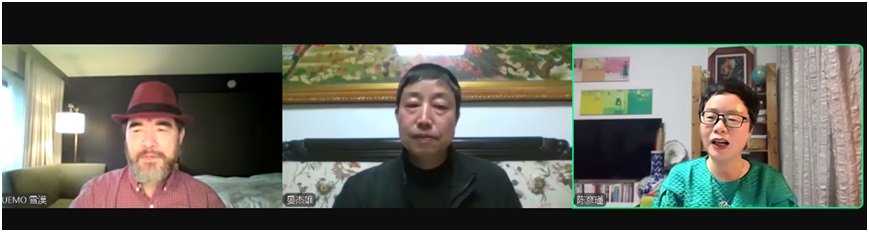
sixth session of “Xuemo in Dialogue with International Scholars” was held
online on April 26, 2026. Organized by the World Literature Union and the Xuemo
Foundation, the event brought together scholars, sinologists, and readers from
China, the United States, Canada, and elsewhere.
Xuemo
and moderator Yanjin Chen were joined by Professor Jiexiong Yan of Central
South University, Professor Riccardo Moratto of Tongji University, and
Associate Professor Min Yang of Bowling Green State University. Their
discussion examined the ideas behind Xuemo’s eight-volume epic, Suosalang, its
literary form, and its place in world literature.
Xuemo on International Awards:
Participation Matters More Than Prizes
Xuemo
had recently returned from the NYC Big Book Award ceremony. At the beginning of
the event, he spoke about the experience and said he attached less importance
to prizes themselves than to the opportunity to participate.
By
attending the NYC Big Book Award, the Oxford Literary Festival, the Guadalajara
International Book Fair, and other events, he said, he had gained a closer
understanding of how publishing and literary institutions operate outside
China. Such participation also allowed more publishers, writers, and readers
abroad to encounter his books and ideas.
Xuemo
described American literary events as well organized and closely connected to
the publishing market. If Chinese writers wish to reach international readers,
he argued, they cannot remain solely within overseas Chinese communities. They
must take part regularly in established literary and publishing networks.
He
called this approach “going global in person.” Physical presence, he said,
gives writers a practical understanding of the people, institutions, and
conventions that shape international publishing.
Award for Wild Fox Ridge
The
prize recognized the English edition of Xuemo’s Wild Fox Ridge. Chen briefly
introduced the novel, which has been described as marking a return to an
earlier phase of Xuemo’s writing.
The
discussion then turned to Suosalang, a work that Chen described as a milestone
in his career. In her view, the epic marked his development from a writer
chiefly associated with contemporary China into one whose work addresses
readers and traditions beyond a single country.
Jiexiong Yan: Cultural Synthesis and
Archetypal Writing
Professor
Jiexiong Yan of Central South University delivered a keynote address titled
“The Convergence of Chinese Civilization and the Archetype of the Epic.” He
described Suosalang as a work that would, in his view, find a lasting place in
world literature and called it “the first modern epic in the Chinese language.”
Yan
organized his reading around five features of the work.
First,
he identified in the book an ancient epic pattern of departure and return.
Second, he noted that its expansive narrative retains the measured pace and
sense of immediacy associated with classical epic. Third, he argued that the
work brings together elements of Confucianism, Buddhism, and Daoism, with
particular attention to the Buddhist principle that appearances arise from the
mind. This emphasis can also be seen in the epic’s extensive portrayal of inner
states.
Fourth,
Yan said that Xuemo places modern language, reflections on life, and
contemporary accounts of human behavior within an ancient epic structure. It is
this combination, he argued, that makes Suosalang a modern epic. Finally, he
described the scale and freedom of its prose as an expression of what Carl Jung
called the collective unconscious, giving voice to experiences that extend
beyond the individual writer.
During
his conversation with Xuemo, Yan asked about the nature of the planet
Suosalang, the relationship between the epic’s two narrative lines, the
artistic sources behind the work, the combination of archaic thought with
modern elements, and the meaning of eternity within the book.
Xuemo
said that Suosalang should not be understood as an invention detached from
experience. It grew out of many years of spiritual practice and close attention
to life. He described his method as open, observant, and self-forgetting, with
the writing arising as an image of a particular inner state.
He
also said that he had tried to address what he regarded as weaknesses in the
characterization of earlier epics. The spiritual life of his characters, he
explained, draws on the traditions of Eastern thought while reaching beyond any
single doctrine. He deliberately wrote in a contemporary idiom that readers
from different cultures could understand.
For
Xuemo, eternity in Suosalang does not mean endless chronological time. It
refers to the completion of an inner life and serves as an image of what human
civilization might seek to become.
Riccardo Moratto and Min Yang: Cultural
Encounter and the Disappearing Author
Professor
Riccardo Moratto of Tongji University asked how Suosalang brings together
different cultural and philosophical traditions.
Xuemo
replied that, by the time he wrote the epic, these traditions no longer felt
like separate materials borrowed from outside. They had become part of his own
intellectual and spiritual life. The result, he said, was not a collection of
labeled influences but a single body of experience.
He
described each of his books as a record of a particular stage in his
development. Conversations with scholars and readers, he added, continue to
shape and enlarge the world from which he writes.
Associate
Professor Min Yang of Bowling Green State University approached the work
through the question of authorship. She asked how a writer can seek to dissolve
the self through spiritual practice while constructing individual selves
through fictional narrative.
Xuemo
said that he had spent several years deliberately breaking down the
recognizable style and authorial identity he had built. Only when that identity
receded, he said, could his characters begin to live independently on the page.
When
writers loosen their attachment to the limited self, he argued, their work
begins to grow more naturally. It may then speak to readers across racial and
cultural boundaries because it draws on experiences not confined to the writer’s
personal identity. He attributed much of his readership to this effort to let
the characters and their world emerge without constant authorial control.
Literature as a Meeting Place
In
his closing remarks, Xuemo said that each discussion with scholars brought
different intellectual worlds into contact and enriched everyone involved. He
hoped that Suosalang and the continuing forum series would allow literature to
connect people, encourage fellow feeling, and help societies look beyond
cultural divisions.
Selected
discussions from the series are expected to appear in the Hong Kong-based
journal World Literature. Plans are also underway to translate and publish them
in English, making the exchanges available to scholars and readers outside
China.

 |
|
 |
|
 |
|


 Mobile
  雪漠推荐
雪漠推荐
 我心中最精彩的青春——《一个人的西部·致