Escaping the “Textual Island”:
Rebuilding the Ecosystem for Chinese Literature Abroad through Textless
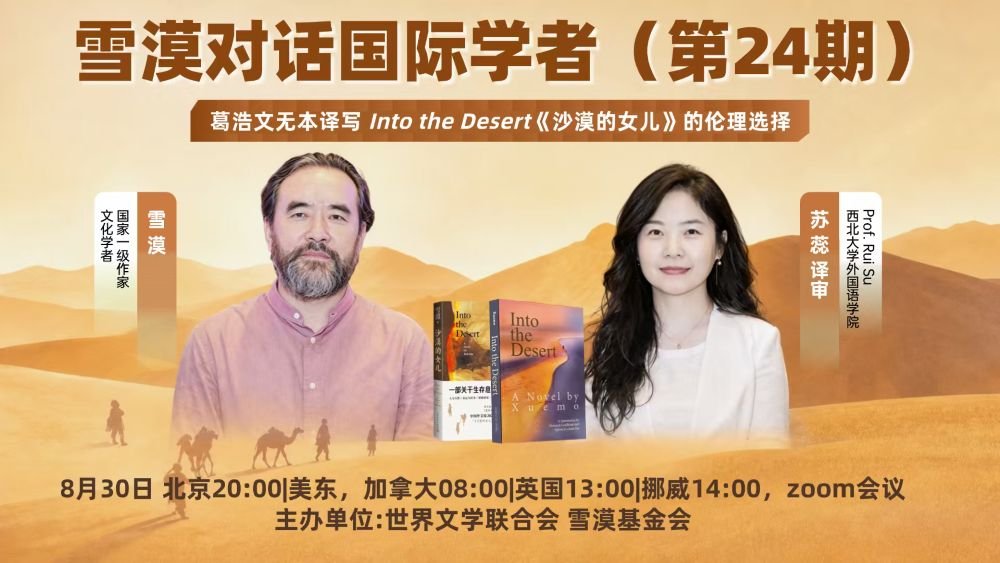
Trans-writing | Xuemo in Dialogue with International Scholars (Episode 24)
On
30 August 2026, the 24th session of “Xuemo in Dialogue with International
Scholars” was held online under the auspices of the World Literature Union and
the Xuemo Foundation. The forum focused on the translation and global
circulation of Xuemo’s works. Professor Su Rui of Northwest University
delivered a presentation on Howard Goldblatt’s ethical choices in his “textless
trans-writing” of Into the Desert (Daughters of the Desert, 《沙漠的女儿》in Chinese). Xuemo attended the discussion, together with scholars including
Associate Professor Xu Gaonan of Shandong University and Associate Professor
Lin Yan of Ningbo University. The conversation explored literary translation,
cultural circulation, and the creation of a cultural ecosystem in the age of
artificial intelligence.
Textless
Trans-writing: A New Perspective on Translation
Professor
Su Rui argued that Into the Desert should not simply be regarded as the English
translation of Xuemo’s Daughters of the Desert. Such an understanding overlooks
the complex process through which the English text was created.
Drawing
on Professor Liu Xiaofeng’s concept of “textless trans-writing,” Su explained
that Into the Desert emerged from a creative process involving selection,
reconstruction, compression, and rewriting across multiple source texts. Rather
than a conventional one-to-one translation, it represents a new narrative
generated from the Desert Trilogy, especially White Tiger Pass and Desert
Rites.
Through
detailed textual comparison, Su demonstrated that Howard Goldblatt and Sylvia
Li-chun Lin did not work from a single source text. Instead, they made a series
of ethical choices while negotiating between the literary world of 1990s
Liangzhou and the expectations of contemporary English-language readers.
Translation
as Ethical Choice
Su
emphasized that translation is never merely a technical operation. Every
decision concerning what to preserve, what to omit, and how to reshape a
narrative involves ethical responsibility.
In
Into the Desert, Goldblatt and Lin chose the story of Lanlan and Ying’er as the
central narrative framework. This choice created a powerful entry point for
international readers by foregrounding two women’s struggle for survival in the
desert. At the same time, it inevitably reduced some of the broader social and
historical dimensions of the original Desert Trilogy.
Su
argued that this was not simply a question of “faithfulness” or
“unfaithfulness.” In textless trans-writing, there is no single original text
to reproduce. The essential question is how translators assume responsibility
when making choices within different ethical environments.
The
Writer’s Openness and the Civilizational Ecosystem
When
asked whether such a transformation changed his creative intentions, Xuemo
responded with openness. He explained that throughout his career he had created
different versions and forms of his works in order to reach different readers.
For
Xuemo, the ultimate purpose is not to protect the author’s name but to allow
wisdom within the works to reach more people. “As long as it benefits readers,
I do not care what method is used,” he said.
He
connected this attitude to his idea of a “civilizational ecosystem.” The
international circulation of Chinese literature cannot depend only on
individual translations or isolated works. It requires a living network
involving writers, translators, scholars, publishers, and readers, where each
participant contributes to the growth of the whole.
From
Textual Island to Civilizational Ecosystem
During
the discussion, scholars explored how literature can become a source of
spiritual nourishment in contemporary society. Xuemo emphasized the importance
of cultivating reading communities and developing deeper relationships between
readers and texts.
Moderator
Yanjin Chen observed that this dialogue extended the previous discussion of
“living transmission.” Xuemo’s practice of selfless writing allows works to
move beyond the boundaries of individual authorship and become part of a
continuously growing cultural ecosystem.
The
forum suggested that the future of Chinese literature abroad lies not only in
exporting texts but in building relationships among creators, translators,
scholars, and readers. Rising above the “textual island” requires a broader
ecosystem in which literature can take root and continue to grow.
Conclusion:
From Textual Island to a Shared Future
The
24th session brought together translation studies, literary theory, and Xuemo’s
reflections on creativity and cultural transmission. It revealed that
cross-cultural communication is not only a matter of transferring words between
languages, but also of creating conditions for genuine understanding.
Through
ethical choices, openness, and collaboration, Chinese literature can move
beyond isolated texts toward a living cultural ecosystem. In the age of
artificial intelligence, this holistic vision offers a possible path for
literature to overcome cultural boundaries and contribute to a shared human
future.

 |
|
 |
|
 |
|


 Mobile
  雪漠推荐
雪漠推荐
 我心中最精彩的青春——《一个人的西部·致