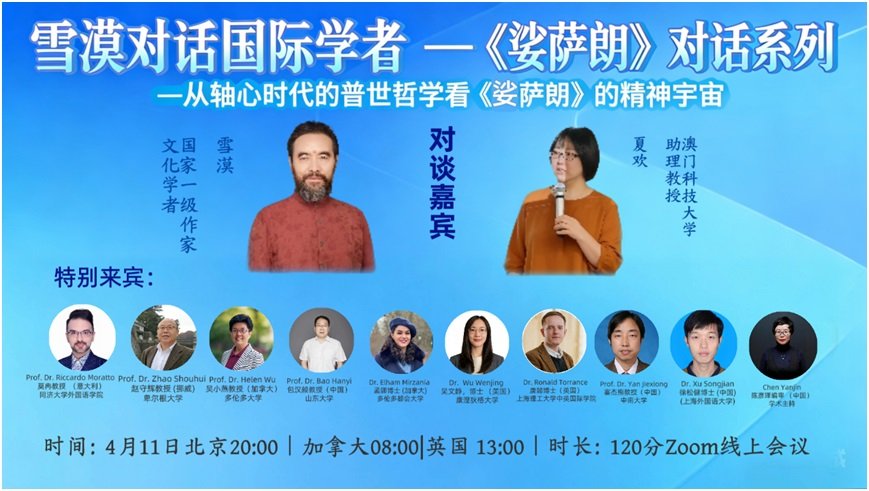
Exploring
the Philosophical Resonances of Suosalang and the Axial Age | “Xuemo in
Dialogue with International Scholars” (Episode 4)
On
April 11, the fourth online session of “Xuemo in Dialogue with International
Scholars,” organized by the World Literature Union and the Xuemo Foundation,
brought together scholars and writers for an international exchange. Titled
“Awakening the Universal Philosophy of the Axial Age: The Spiritual Universe of
Suosalang,” the session featured a keynote address by Dr. Huan Xia, Assistant
Professor at the Macau University of Science and Technology. She joined the
renowned writer Xuemo and scholars and guests from around the world in an
in-depth discussion.
An Epic Masterpiece and the Search for a
Universal Philosophy
This
session continued the forum’s exploration of Xuemo’s monumental epic Suosalang.
In her opening remarks, moderator Yanjin Chen announced that the forum’s
discussions would be compiled and edited by Professors Riccardo Moratto and
Ying He and published internationally in both Chinese and English, further
promoting Chinese scholarship and literature to a global readership.
Xuemo
opened by reflecting on his recent participation in literary events and
cultural outreach activities in the United Kingdom and the United States. He
emphasized the cumulative value of sustained cultural engagement, comparing
seemingly disparate exchanges to individual stones used to construct a great
edifice. Once systematically organized and published—and further developed
through artificial intelligence and big-data technologies—the knowledge
generated through such exchanges could become a shared cultural resource with a
lasting global influence.
Dr.
Huan Xia’s Keynote Speech: From the Axial Age to the Spiritual Universe of
Suosalang
Drawing
on comparative perspectives from history and philosophy, Dr. Xia situated
Suosalang within the theoretical framework of the Axial Age and offered a
three-tiered interpretation of the work.
Withdrawal from and Engagement with the
World
Drawing
on the statement in the Analects that “the village worthy is the thief of
virtue,” together with the story of Bhishma in the Indian epic Mahabharata, Dr.
Xia considered whether capable individuals should withdraw from the world to
avoid conflict. She also examined how those who choose to engage with society
might navigate their relationship with the desire for fame, status, and
material gain.
Spirit and Matter
Introducing
ancient Greek philosophy and Gnostic discussions of the relationship between
spirit and matter, Dr. Xia suggested that Suosalang’s pursuit of the eternal
spirit resonates with Karl Jaspers’s vision of a renewed or “second” Axial Age.
The Inner Struggle
Dr.
Xia interpreted the conflicts in Suosalang as more than historical struggles or
contests for worldly power. They also represent the human spirit’s struggle to
overcome itself. Relating the work’s depictions of “hell” to the technological
age, she raised an urgent contemporary question: in a materially advanced
“Promethean Age,” how can the human mind break free from illusion and
suffering?
Xuemo’s
Response: The Unity of Mind and Matter and Active Engagement with the World
Xuemo
offered wide-ranging and insightful responses to the questions raised by Dr.
Xia.
On Withdrawal from and Engagement with
the World
Xuemo
argued that withdrawing from the world without serving it may, in a certain
sense, constitute a moral failing. He cited the example of Shakyamuni Buddha,
who, after attaining enlightenment, chose not to enter nirvana immediately but
instead remained in the world to teach the Dharma. For Xuemo, this demonstrates
that genuine awakening necessarily leads to altruistic engagement with the
world.
He
acknowledged that such engagement can become entangled with the pursuit of
fame, status, and material gain, and may consequently bring suffering.
Nevertheless, he maintained that action contributing to the advancement of
human civilization should be encouraged as a form of constructive engagement.
He advocated “acting without attachment to action”: participating actively in
the world while remaining inwardly detached and spiritually transcendent.
On the Nature of the Material World
Drawing
on the “observer effect” in quantum mechanics, Xuemo argued that the material
world possesses no absolute or inherent moral character; its significance
depends on the observer’s state of mind. When the mind is enslaved by material
things, matter becomes a source of distress. When the mind transforms matter
into spiritual energy and a vehicle for higher meaning, however, the material
world can become a pure land.
Xuemo
described the Eastern wisdom of the “unity of mind and matter” embodied in
Suosalang. Through specific forms of spiritual practice, including the
“Three-Branch Method,” practitioners can learn to perceive all phenomena as
manifestations of a pure mandala, thereby moving beyond the Gnostic dualism of
spirit and matter.
On Contemporary Challenges and Personal
Experience
Dr.
Xia also asked how people might inwardly assimilate their material experiences
in an age of information overload. She reflected on the sense of liberation
that individuals may experience through an encounter with nature.
In
response, Xuemo referred to astronauts whose views of life changed profoundly
after seeing Earth from space. Such experiences, he suggested, demonstrate how
a change in perspective can produce a fundamental transformation in
understanding. He affirmed the value of these moments while stressing that
fleeting insight must be transformed into a stable worldview and sustained
spiritual practice. Only then can individuals preserve inner peace and strength
amid the turbulence of worldly life.
International Scholars Build a Platform
for Intellectual Exchange
The
forum brought together internationally recognized scholars and emerging researchers,
including Riccardo Moratto, Distinguished Professor at Tongji University;
Professor Shouhui Zhao of the University of Bergen in Norway; Professor Helen
Wu of the University of Toronto in Canada; Professor Hanyi Bao of Shandong
University; Iranian scholar Dr. Elham Mirzania; and Dr. Yi Tang, Dr. Pingyan
Li, Dr. Songjian Xu, and Dr. Wenjing Wu, among others.
Their
participation reflected the forum’s growing academic influence and the
increasing international interest in Xuemo’s work.
The
event was marked by rigorous scholarship and lively intellectual exchange. Dr.
Xia’s questions combined philosophical depth with a keen awareness of
contemporary concerns, while Xuemo’s responses brought together literary
creation, the philosophy of mind and human nature, and perspectives drawn from
contemporary science. Their dialogue offered new ways of understanding the
deeper significance of Suosalang and its relationship to the intellectual and
spiritual legacy of the Axial Age.
The
forum concluded with a thought-provoking discussion that demonstrated the
distinctive power of dialogue between literature and philosophy.

 |
|
 |
|
 |
|


 Mobile
  雪漠推荐
雪漠推荐
 我心中最精彩的青春——《一个人的西部·致