When
Entropy Meets Empathy: A Cross-Cultural Ethical Reading of Xuemo’s Fiction |
“Xuemo in Dialogue with International Scholars” (Episode 10)
At 8
p.m. Beijing time on May 24, 2026, the tenth session of “Xuemo in Dialogue with
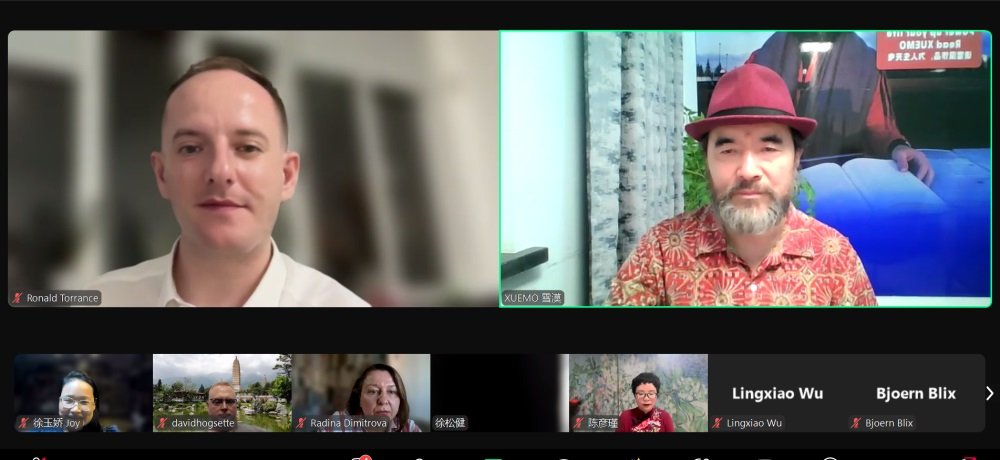
International Scholars” was held online. Fifteen scholars, writers, and
translators from more than ten countries, including China, the United Kingdom,
Italy, Norway, Canada, the United States, and Mexico, joined a discussion
titled “From Entropy to Empathy: A Reader-Response Study of Xuemo’s Fiction.”
Organized
by the World Literature Union and the Xuemo Foundation, the two-hour forum drew
nearly 200 online participants.
An Interdisciplinary Reading of Xuemo’s
Fiction
At
the beginning of the forum, moderator Yanjin Chen introduced the two principal
speakers: Xuemo, a contemporary Chinese writer and cultural scholar, and Dr.
Ronald Torrance, a lecturer at the University of Shanghai for Science and
Technology who holds a doctorate in contemporary Chinese literature from the
University of Strathclyde.
Xuemo
has published more than 80 works of fiction and cultural commentary. His books
have been translated into nearly 30 languages, with nearly 60 foreign-language
editions in circulation. They have received honors including the Independent
Press Award and the NYC Big Book Award.
Torrance’s
research concerns modern and contemporary Chinese literature and its
circulation across national borders. Drawing on the physical concept of entropy
and the principles of reader-response criticism, he examined how Xuemo’s
narratives move from disorder and suffering toward empathy and ethical
reflection.
His
argument followed three related ideas: entropy, empathy, and ethics.
Entropy as a Literary Concept
In
thermodynamics, entropy describes the growth of disorder, the dissipation of
energy, and the irreversibility of physical processes. Torrance applied the
term to fiction marked by emotional fragmentation, uncertainty, unresolved
suffering, and forms of stability that never last.
He
also drew on reader-response theory, which holds that meaning arises through
the encounter between a reader and a text rather than residing entirely within
the text itself.
Xuemo’s
fiction, Torrance argued, does not allow readers to remain detached observers.
Its immersive narratives require them to spend time within the conditions
endured by the characters.
Four Features of Xuemo’s “Entropic”
Narratives
Torrance
identified four ways in which entropy appears in Xuemo’s fiction.
1.
Suffering as an Environment
In
many works of fiction, suffering arrives as an exceptional or dramatic event.
In Xuemo’s writing, it forms the lasting background of ordinary life.
His
characters live for long periods with poverty, exhausting labor, silence, and
emotional isolation. Readers, in turn, are asked to remain within that
atmosphere rather than pass quickly through it.
2.
Landscape as Psychology
The
deserts of western China are more than geographical settings. They also reflect
the characters’ states of mind.
Barren
landscapes suggest emotional depletion, while uncertain journeys expose the
vulnerability of human existence. Episodes involving encircling wild dogs or
dangerous desert crossings maintain a pressure that is psychological as well as
physical.
3. A
Refusal of Conventional Form
Xuemo’s
slow narrative pace extends the reader’s experience of suffering. His stories
resist happy endings and heroic reversals. Death and impermanence recur,
leaving emotions unresolved after the book has ended.
4.
Love Without Resolution
In
Eternal Love, love remains bound to illness, separation, and vulnerability. The
novel offers no easy consolation. Readers must live with the characters’
regrets and with hopes whose fulfillment remains uncertain.
From Entropy to Empathy
Torrance
summarized his argument in one sentence: “Entropy is not the destination but
the entrance to empathy.”
Readers
may begin with confusion, discomfort, or instability. As they continue,
however, they accompany the characters through suffering. Identification with
an individual character can then give way to ethical questions about suffering
more generally.
Can
people retain their kindness under extreme pressure? Does endurance have
meaning? Can moral life survive when the world around it has broken down?
Xuemo’s
fiction does not provide fixed answers or press readers toward a prescribed
emotional response. Its uncertainty requires them to take part in making
meaning. They do not simply witness another person’s story; they bring their
own experience into the text.
Torrance
described this as a movement from experiencing suffering to understanding
compassion.
He argued
that such writing speaks to the spiritual unease of an age dominated by
fragments of information. Literature need not solve the problems of the world.
By presenting them honestly, however, it can help readers form a more serious
connection with other people and with the conditions they share.
Xuemo
agreed with much of this reading and related it to his experience of life in
western China.
“Life
itself is a process of increasing entropy, moving from purity toward disorder,”
he said. “Literature should not preach cultural lessons or claim to solve
problems. It should present them honestly.”
He
compared his fiction to Laozi’s Eight Trigrams Furnace in Journey to the West.
Readers enter the text as the Monkey King enters the furnace. Their encounter
with the characters tempers them until they emerge with “fiery eyes and golden
pupils,” able to see more clearly. In Xuemo’s account, empathy can lead readers
from experiencing suffering toward transcending it.
He
also said that his writing had changed in recent years. His early ambition was
to record the life of western China. He now thinks of writing more simply as a
form of companionship.
“Writing
is no longer a record,” he said. “It means staying with readers and guarding an
inner light amid disorder.”
Scholars Discuss Literature Across
Cultures
The
participating scholars brought expertise from several related fields. Riccardo
Moratto, Distinguished Professor at Tongji University, has long worked to bring
Chinese literature to international readers. Shouhui Zhao of the University of
Bergen specializes in Chinese-language education abroad, while Radina Plamenova
Dimitrova of the National Autonomous University of Mexico studies and
translates Chinese literature for Spanish-speaking readers. Norwegian scholar
Bjoern Aage C. Blix focuses on the reception of Chinese culture across
languages and national borders.
During
the question-and-answer session, Lingxiao Wu, a doctoral candidate at Peking
University, asked about the autobiographical elements in Xuemo’s work.
Xuemo
replied that the writing he had done after the age of 60 had largely shed its
regional labels.
“At
the end of life,” he said, “what remains is the sincere companionship between
one person and another.”
Asked
how entropy becomes empathy, Torrance drew a distinction between empathy and
compassion. Empathy begins when readers enter imaginatively into a character’s
feelings. Compassion goes further, turning that identification into an ethical
concern for the suffering shared by human beings.
The
movement between the two, he said, allows Xuemo’s fiction to connect personal
experience with values that are not confined to one culture.
Young
writers Yixin Chen and Jianxin Chen approached the question from the writer’s
point of view.
“Writing
is itself a way of resisting entropy,” they said. “Xuemo writes about the most
genuine warmth within disorder, the strength we are all seeking not to be
overwhelmed by suffering.”
The Courage to Show Vulnerability
At
the end of the forum, Xuemo told a story about a new puppy in his home. The dog
often rolls onto its back and exposes its belly, showing complete trust.
Xuemo
compared that gesture to what he values most in literature: the courage to
reveal what is vulnerable.
“We do
not have to pursue greatness or success,” he said. “If we can entrust our
hearts to one another sincerely, the world is already good enough.”
Chen
described the event itself as an exercise in empathy. Scholars set aside
disciplinary barriers, writers gave up the authority of the lectern, and
readers ceased to be spectators. Through literature, they entered a
conversation in which intellectual judgment and emotional attention could meet.
A
two-volume Routledge collection devoted to Xuemo’s work is scheduled for
publication at the end of 2026.

 |
|
 |
|
 |
|


 Mobile
  雪漠推荐
雪漠推荐
 我心中最精彩的青春——《一个人的西部·致