The
Desert Is Silent, but the Dialogue Is Not: Riccardo Moratto in Conversation
with Xuemo, an MCLC Interview | “Xuemo in Dialogue with International Scholars”
(Episode 9)
On
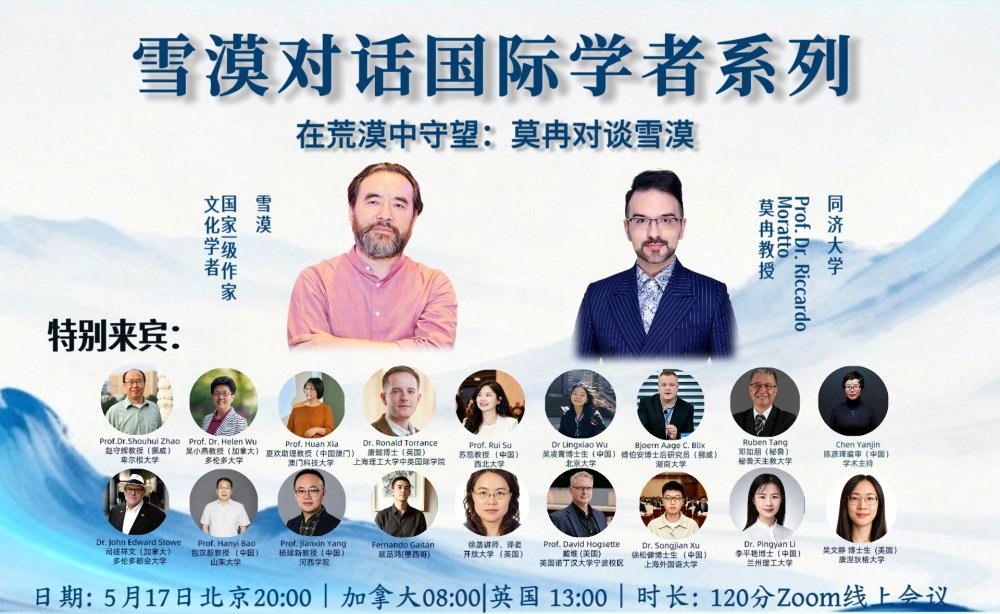
the evening of May 17, 2026, the World Literature Union and the Xuemo Foundation
held the ninth session of “Xuemo in Dialogue with International Scholars” via
Zoom.
More
than 20 sinologists, translators, and literary scholars from China, Italy,
Norway, Canada, the United Kingdom, the United States, Peru, Mexico, Denmark,
and other countries joined the event. Their discussion covered the development
of Xuemo’s writing, the ideas behind his work, and its reception across
cultures. Yanjin Chen, author of The Xuemo Code, moderated the event.
Xuemo’s
principal interlocutor was Riccardo Moratto, an internationally known
sinologist and Distinguished Professor at Tongji University. Moratto has edited
several academic book series for Routledge and was named a “Friend of Chinese
Literature” in 2025. A two-volume Routledge collection on Xuemo, under
Moratto’s general editorship, is scheduled for publication at the end of 2026.
From Western China to Questions of
Civilization
Speaking
in both Chinese and English, Moratto traced a series of questions through
Xuemo’s writing life. He asked how Xuemo had moved beyond the label of a
“western Chinese writer,” how the pen name “Xuemo” had acquired its meaning,
and how the oral culture of his childhood had shaped his prose.
The
conversation also covered the 12 years Xuemo spent writing Desert Rites, the
difference between his “spiritual realism” and Latin American magical realism,
the relationship between spiritual practice and writing, and his approach to
female characters. Behind these questions lay a larger concern: What can
literature still do in an age of fragmented attention?
Xuemo
divided his career into three stages: writing about western China, interpreting
culture, and examining civilization. His present work, he said, is no longer
confined to one region but addresses problems faced by people across societies.
“Civilizations
of the past often disappeared because they lacked the ‘genes of longevity,’” he
said. “If literature does nothing but tell stories, and if cultures remain
separated by barriers, neither can answer the needs of the age. I want to bring
literature and culture together with the idea of Xin-xing Civilization (心性文明), a
form of civilization grounded in the cultivation of the heart-mind and human
nature. I hope this can bring a little more light and a little less violence
into the world.”
Three Realms of Reality
The
conversation soon moved beyond literary history. Asked about supernatural
elements in his work, Xuemo described a threefold understanding of reality.
A
writer, he said, works not only with physical and social reality but also with
a hidden realm connected to the mind. The movement among these three realms
reflects the traditional Chinese idea of unity between humanity and the cosmos.
On
the subject of women, Xuemo said that great mothers do not need to prove their
worth through worldly achievement.
“The
devotion found in their daily lives,” he said, “often reaches a level that many
recognized sages never attain.”
Toward
the end of the interview, Xuemo turned to the relationship between technology
and civilization.
“Artificial
intelligence is, in essence, humanity’s discovery of intelligence in nature,”
he said. “Eastern and Western civilizations may eventually meet in the
recognition that the world itself is an immense intelligent being.”
Silence, Translation, and Spiritual
Realism
The
scholars’ discussion opened with a question from Dr. John Edward Stowe of
Toronto Metropolitan University about the aesthetic relationship between
silence and what remains unwritten.
“The
greatest forms of language teach us how to speak within silence,” Moratto
replied.
Lingxiao
Wu, a doctoral candidate at Peking University, asked how translators should
respond to the Orientalist assumptions that Western readers may bring to
Chinese literature.
Moratto
said that translation should “turn a landscape into a home rather than an
exotic decoration.” A translator’s task, in his view, is not to heighten a
work’s foreignness but to help readers enter the human world within it.
Wenjing
Wu, a doctoral candidate at the University of Connecticut, asked about the
relationship between women’s suffering and transcendence in Xuemo’s fiction.
Xuemo
answered with stories about the mothers of Mencius and Confucius. Their lives,
he said, show that selfless devotion is not merely a moral virtue but a form of
wisdom.
Professor
David S. Hogsette of the University of Nottingham Ningbo China asked about the
historical foundations of “spiritual realism.” His exchange with Xuemo examined
the different layers of history, belief, and cultural memory that lie behind
the term.
A Weekly Conversation Across Cultures
“Xuemo
in Dialogue with International Scholars” is held each Sunday at 8 p.m. Beijing
time. The series uses literature as a point of departure for public discussions
among writers and scholars working across languages and intellectual
traditions.
At
the end of the event, Chen quoted Fernando Pessoa: “To write is to make
something eternal.”
“To
speak is also to make something eternal,” she added. “Every conversation adds
something to humanity’s intellectual and spiritual inheritance. We hope more
scholars will join us as we look together for gentler answers to the problems
of our world.”

 |
|
 |
|
 |
|


 Mobile
  雪漠推荐
雪漠推荐
 我心中最精彩的青春——《一个人的西部·致