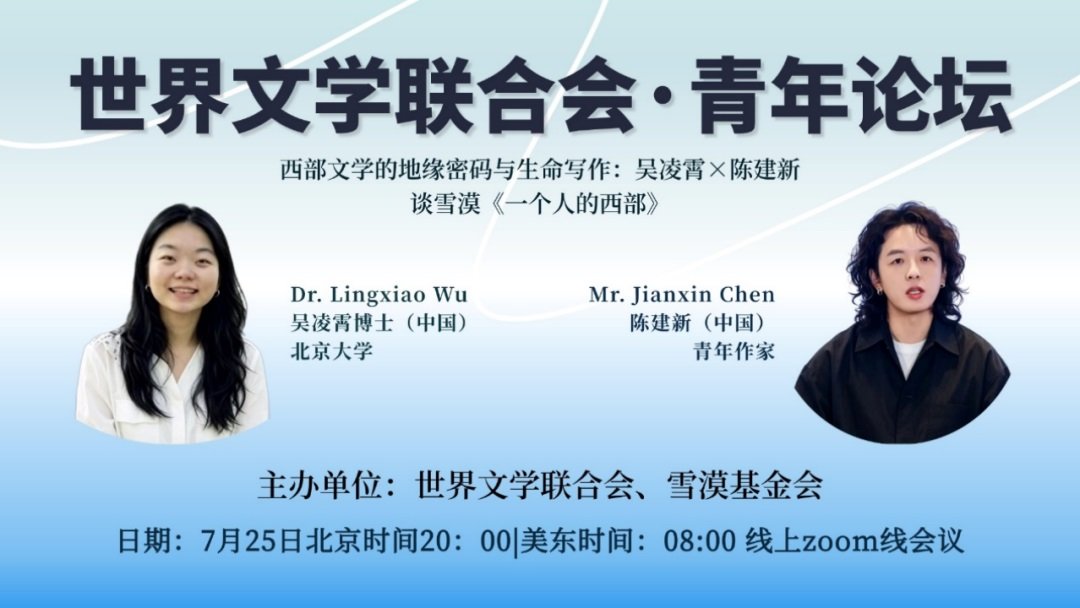
Exploring the Contemporary Relevance
of Xuemo’s Autobiography | World Literature Union Youth Forum (Episode 1)
The
first World Literature Union Youth Forum, jointly organized by the World
Literature Union and the Xuemo Foundation, was held on Zoom at 8 p.m. Beijing
time on July 25, 2026. The forum was moderated by Xu Yujiao (Joy), secretary of
the World Literature Union and an editor responsible for the international
presentation of Xuemo’s works. Under the theme “The Geographical Codes of
Literature from Western China and Life Writing,” the forum brought together Wu
Lingxiao, who holds a doctorate in literature from Peking University and
researches literary geography and biographical literature, and Chen Jianxin, a
young writer born in the 1990s, for an in-depth conversation. More than ten
young scholars and doctoral students from China, Spain, Nepal, and other countries
joined the online discussion, while more than 80 readers watched the
livestream.
Geographical
Codes: How the Land Shapes One’s Inner Life
Opening
the forum, Dr. Wu Lingxiao drew on Hippolyte Taine’s theory of “race, milieu,
and moment” and the “spatial turn” in contemporary human geography to pose a
central question: when we speak of the “western genes” of literature from
western China, are we referring simply to physical landscapes such as the Loess
Plateau, deserts, and the Gobi? Or are we asking how these spaces enter a
writer’s lived experience and are transformed into the inner structures of a
culture?
Chen
Jianxin, who grew up in Liangzhou, Gansu, responded strongly to this question.
He observed that in One Man’s West, Xuemo deliberately avoids reducing western
China to emblematic images such as “a lone plume of smoke over the vast
desert.” Instead, he begins with villages barely visible on a map and writes
about people struggling for water, contending with the land, and negotiating
the complex realities of survival among neighbors. “Xuemo does not stand
outside western China and observe it. He takes life itself as his method,
allowing the land, history, family, and faith to permeate the self together.”
Chen singled out the philosophy of Xuemo’s father in the book: “Whatever Heaven
dishes out, I can take.” This, he explained, is not passive submission to adversity,
but the strength to remain upright while accepting that some turns of fate
cannot be resisted. This inwardly directed spirituality, forged amid material
scarcity, is a defining quality of literature from western China.
Discussing
the book’s many “supernatural elements,” including prayers for rain, rituals to
ward off misfortune, and Qimen Dunjia divination, Chen argued that they provide
an important way of understanding the geographical codes of western China. “For
the older generation in western China, the belief that all things have spirits
is not superstition, but a form of wisdom for survival.” Referring to the
Leitai site in Liangzhou and the folk magic practiced by Xuemo’s uncle as
described in the book, he explained how mythic thinking gives people living in
harsh conditions a framework of meaning and a way to engage with fate. “It
makes suffering explicable and allows people to enter into a dialogue with
fate. Where the light of science does not reach, this way of thinking keeps
people from falling into utter despair. In western China, despair is the real
death.”
Life
Writing: Dialogue with the Self and the Preservation of Memory through
Multidimensional Narrative
In
the section on “The Rich Dimensions of Life Writing,” Dr. Wu focused on the
distinctive narrative structure of One Man’s West: the 50-year-old Xuemo writes
about the 20-year-old Xuemo, while the 20-year-old imagines how his 80-year-old
self might look back on the present. This “three-dimensional narrative” breaks
with linear time, turning autobiography from a one-way act of recollection into
a roundtable conversation among different selves across time and space.
Comparing
this technique with the celebrated opening of Gabriel García Márquez’s One
Hundred Years of Solitude, Wu argued that its value lies in restoring the
complexity of growing up. “The selves of every age are crowded into the same
body. The impulses of eighteen, the weighing of choices at thirty, and the
clarity of fifty pull against and complete one another. Growing up is not a
straight line from A to B, but a cycle we can enter again and again.” For Wu,
the confused and struggling 20-year-old Xuemo is the most compelling. “This is
not a ‘dream of becoming a writer’ packaged in the language of success
formulas. It is the genuine uncertainty of an ordinary young person confronting
the future.”
The
two speakers also discussed the intertextual relationship between autobiography
and fiction. Chen noted that a childhood detail in the memoir, “Chuanxing Nü
roasting soybeans,” later entered Xuemo’s novel Curses of the Kingdom of Xixia.
This movement “from life into literature” creates a distinctive reading
experience. From the perspective of literary theory, Wu argued that such
intertextuality blurs the boundary between reality and fiction, allowing
readers both to feel the warmth of lived experience and to appreciate the
appeal of artistic transformation. “As Woolf said, fiction is the radiance of
the rainbow, while truth is hard stone. It is the coexistence of the two that
makes literature so captivating.”
Possibilities
for Action: Recovering a Sense of Direction in the Age of AI
Against
the rapid change and emotional numbness of contemporary society, the forum
turned to affect theory and Gilles Deleuze’s concept of “rhizomatic thinking”
to explore what Xuemo’s life choices might offer young people today. Wu
observed that young people are often constrained by “arborescent thinking”:
they are expected to proceed step by step through school, work, and marriage,
growing like trees along a prescribed path, with any deviation treated as
“failure.” By contrast, Xuemo’s trajectory, from dreaming of becoming a
chivalrous hero like Sun Wukong, to dreaming of becoming a writer, to
informally learning to draw at the age of 54, reveals a fluid process of
continual transformation.
Chen
strongly agreed. “Xuemo’s dream is not a fixed destination, but an enduring
sense of direction. This ‘transformation’ is, at its core, a resistance to
social coding.” He cited Xuemo’s failure in the university entrance
examination, the death of his younger brother from illness, and a period when
he could no longer write to illustrate how existential difficulties often
cannot be resolved by “finding the standard answer.” Instead, they may require
letting go of an obsessive attachment to outcomes. “He let go of the insistence
that he ‘had to become a writer’ and turned to meditation. In doing so, he
recovered his ability to write. This is deeply illuminating for young people
caught in relentless competition: what traps you is often not reality, but the
very thought that you ‘have to become somebody.’”
To
explore the dialectical relationship between staying rooted and leaving home,
the two speakers used a pair of compasses as a metaphor. Xuemo’s mother,
holding fast to her three-fen plot of land in Liangzhou, is the fixed leg;
Xuemo, traveling to Lingnan and then farther into the world, is the other leg,
continually drawing circles. “Neither is superior to the other. Both embody the
spirit of western China: the resolve not to turn back once a choice has been
made, and the willingness to take full responsibility for that choice,” Chen
said. “True wandering is never rootless drifting. It means exploring the world
while carrying the imprint of one’s original home.”
Breaking
New Ground within Tradition: How Writing Preserves a Disappearing Culture
In
the final section, “Inheriting Tradition and Breaking New Literary Ground,” Wu
introduced Harold Bloom’s theory of the “anxiety of influence” to ask how young
writers might find themselves within tradition. Chen said candidly that Xuemo’s
greatest influence on him lay in redefining what writing means. “Writing is not
a profession or a tool for attracting clicks, but a practice of cultivating
one’s life. Xuemo spent twelve years writing Desert Rites, not revising the
words over and over, but allowing his life to grow until it could bear the
weight of the work.”
Reflecting
on the decline of Liangzhou wedding traditions, including the roles of the
“eastern guests” and “western guests,” Wu argued that writing plays an
irreplaceable role in preserving cultural memory. “Rituals give us the warmth
of being there; writing makes it possible to travel through time.” He cited
anthropologist Joseph Rock’s documentation of the Naxi people’s Dongba culture
and argued that Xuemo’s writing about Liangzhou xianxiao storytelling, dialect,
and folk customs is, in essence, preserving the “spiritual coordinates” of a
culture on the verge of disappearing. “A hundred years from now, readers may no
longer be able to see Liangzhou as it really was, but through these words they
will feel that land breathing. This is a writer’s deepest declaration of love
for home.”
Conclusion:
Everyone Has a “West” of Their Own
Lasting
more than two hours, the conversation moved from literary geography to the
philosophy of life, and from the preservation of tradition to the challenges of
living in the age of AI, combining theoretical depth with the warmth of lived
experience. In her closing remarks, moderator Xu Yujiao said: “We read One
Man’s West today not to seek out the exotic barrenness of western China, but to
see clearly, amid the clamor of our times, how one person can hold on to a
dream in conditions of scarcity and find a ‘sense of direction’ amid
uncertainty. May each of us have within us a west that is vast, free, and
endlessly alive.” The forum ended with a promise to “meet again next Saturday.”
The conversation will be collected and published as a record of the inaugural
Youth Forum.
The
World Literature Union Youth Forum will be held regularly, focusing on readings
of Xuemo’s works and the academic development of young scholars. The Third
International Research Competition on Xuemo’s Works, jointly organized by the
World Literature Union and the Xuemo Foundation, is also scheduled to launch
officially in August. Supported by numerous universities, associations, and
literary journals, the competition welcomes participation from more
organizations, platforms, and scholars in China and abroad.

 |
|
 |
|
 |
|


 Mobile
  雪漠推荐
雪漠推荐
 我心中最精彩的青春——《一个人的西部·致