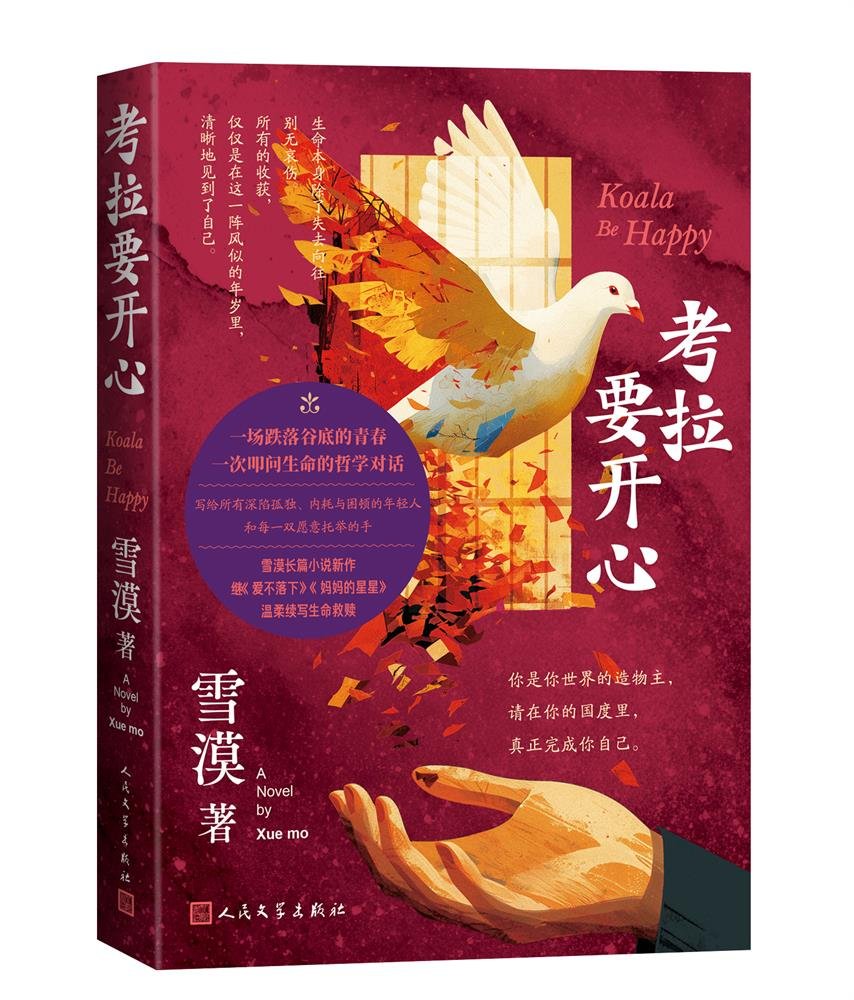
Koala, Be Happy: A Young Woman’s
Struggle and Search for Happiness—World Literature
Union Youth Forum · Session 6
On
September 5, the World Literature Union and the Xuemo Foundation hosted an
online discussion of Xuemo’s new novel, Koala, Be Happy, for the sixth session
of the World Literature Union Youth Forum.
Qiuzi,
who has studied Xuemo’s work for more than a decade, delivered a keynote
speech. Yanjin Chen of People’s Literature Publishing House, the novel’s
editor, shared the book’s development and readers’ responses. Many scholars,
young researchers and readers also attended.
The
novel follows a young woman whose troubled family history, wrong decisions and
her failure to meet social expectations end in tragedy. Participants discussed
her pursuit of happiness and considered how people cope when life brings them
pain and disappointment.
The
Pressure to Be Happy
Qiuzi
began by analyzing the title. He read “Koala, Be Happy” as both a wish for the
protagonist and a personal pursuit of what she wants for herself. The
difficulty, he suggested, lies in expecting everything to go well so that she
is protected from everything she finds painful.
He
linked Koala’s behaviour to emotional wounds dating back to her family life.
She lacks a sense of security and depends heavily on other people’s approval.
When she cannot find reassurance, she looks for ways to escape.
Qiuzi
admitted that “as long as I’m happy” can often serve as a “mantra.” Someone
under pressure may need to stop measuring every decision against other people’s
expectations. But Koala uses the same attitude to avoid confronting her every
setback in life. It gives her temporary relief without helping her deal with
the consequences of her choices.
Her
story leads to a question that we often neglect: if we expect life to be easy
all the time, how do we respond to experiences that inevitably hurt us?
Learning
to Live with Disappointment
Chen
asked whether happiness depends on favourable circumstances or on a person’s
ability to cope when those circumstances change.
Drawing
on Confucian, Buddhist and Daoist thought, Qiuzi argued that reliance on
external approval makes people vulnerable. A relationship may end, someone’s
opinion may change, or an expected opportunity may disappear. People need
something that can sustain them through such losses.
He
described three practices: self-cultivation, emotional balance and public
service.
Through
self-cultivation, he explained, people examine their values and decide what
deserves their commitment. Emotional balance helps them respond to success and
failure without allowing either to dictate every action. Concern for others
gives them responsibilities and interests beyond their immediate feelings.
In
Qiuzi’s account, a person who has something worthwhile to do does not need to
keep asking whether they feel happy. Satisfaction can be produced from the
work, relationships and commitments they make.
He
connected this argument to Xuemo’s exploration of Heart-mind Civilization. The
novel tests these ideas through a character’s real-life decisions and their
consequences.
How
the Book Got Its Title
Chen
recalled that the manuscript was originally titled The Tattooed Heart. During
the editing process and reader research, she had an epiphany, and the phrase
“Koala, be happy” lingered in her mind. She discussed it with author Xuemo, and
they agreed on the book title of the simplified Chinese version, Koala, Be
Happy.
Readers’
responses after publication appeared to support the choice. The familiar slogan
to “be happy” is a sign for people who feel anxious, exhausted or disappointed.
It expresses a sincere wish, but it can also leave them wondering why they
cannot feel the way they are expected to.
The
discussion addressed the gap between those expectations and common human
experience. Life includes frustration, loss and uncertainty. Participants
considered whether accepting these experiences might help people respond to
them more effectively.
Koala’s
problem is that she seeks relief from painful feelings without establishing a
correct way to cope with them. Her story prompted a further question: how much
control can people exercise over their responses, even when they cannot control
what happens to them?
The
Questions Behind Koala’s Story
The
forum connected this question to the novel’s treatment of family trauma, social
pressure and personal responsibility. Koala’s circumstances help explain her
choices, while the consequences of those choices give the discussion its
urgency.
Xuemo
uses a fantastical narrative to examine these connections. The loss of a young
life asks readers to consider what might have helped her: a better
understanding of her emotions, the ability to face disappointment, and a
purpose beyond personal fulfillment.
For
Qiuzi, concern for other people was essential to that purpose. Someone who
recognises that their actions matter to others has a reason to remain engaged
with life, even during periods of unhappiness. His reading of the novel placed
that responsibility at the heart of its account of self-understanding and the
possibility of self-redemption.
Happiness
and the Inner Life
This
led Chen to ask a question about the source of happiness: does it come from the
conditions in which people find themselves, or does it depend on how firmly
their inner lives are grounded?
Qiuzi
offered a thoughtful response, drawing on Confucian, Buddhist and Daoist
thought. In his view, happiness that depends on other people’s approval is
especially fragile. When a relationship changes, when others judge a person
differently, or when familiar living conditions are disrupted, the pleasure
that depended on them may disappear just as quickly. What gives people the
strength to live is not the promise of uninterrupted ease and happiness. It is
the ability to remain open-minded and composed even when they encounter
disappointment, failure or suffering. Such strength allows people to face
difficulties without losing their sense of inner stability.
He
summed up this process as “self-cultivation, emotional balance and public
service”. Self-cultivation means establishing a foundation for life that does
not depend entirely on external circumstances. Emotional balance means
developing the ability to remain steady, so that gains, losses and changing
feelings do not constantly pull one’s inner life in different directions.
Public service, in this sense, means gradually extending one’s concern beyond
“Am I happy?” to include “Are others happy?” The concern is no longer with the
quality of one’s own feelings, but with the well-being of other people. When
someone has a sense of direction in life that matters more than their personal
need, happiness need not be forced. Like fruit that falls when it is ripe, it
can follow naturally as that purpose takes shape. The novel offers a vivid
example of how Xuemo puts his philosophy of the heart-mind into literary
practice.
Chen
then described how the title had taken shape, recalling the process from her
perspective as the novel’s editor. The manuscript was originally called The
Tattooed Heart. As she worked on the text and gathered readers’ views, the
phrase “Koala, be happy” struck her as particularly moving. After repeated discussions with
Xuemo, it was confirmed as the title of the simplified Chinese edition. The
public response after publication supported her judgment. The widespread
insistence that people should “be happy” exists alongside a less comfortable
reality: many are caught in exhausting cycles of worry and self-doubt. The
repeated call for happiness reveals how difficult it is for so many people to
feel happy at all.
She
then asked what happens when the life we actually experience does not match the
life we had expected. Do we have the capacity to accept disappointment and make
room for the imperfections of ordinary life?
Koala’s
predicament offers a warning about happiness pursued solely as a pleasant
emotional state. Without the inner strength needed to support and sustain it,
such happiness remains fragile. The question therefore shifts from “Why should
I be happy?” to “How can I take charge of my own happiness?” This means asking
whether we can stop treating happiness and unhappiness as absolute opposites,
with one to be pursued and the other rejected. Can we make room for the
experiences we would not choose, as well as those we welcome? Can we accept the
full range of circumstances life brings and face its changes, joys and sorrows
with greater composure?
This
is where the novel’s literary value meets its relevance to contemporary life.
Koala, Be Happy offers no standard answer to the problem of happiness. Through
a fantastical narrative centred on a young woman’s death, Xuemo examines the
relationships between family trauma, work pressures, personal fixations and
inner growth. Those relationships are explored gradually, encouraging readers
to reexamine their own lives. Lasting happiness, in this account, is possible
when people are no longer self-centered. They must step out of their comfort
zone and into the wider world, develop a firmer faith and bring greater
stability and order to their inner lives.

 |
|
 |
|
 |
|


 Mobile
  雪漠推荐
雪漠推荐
 我心中最精彩的青春——《一个人的西部·致