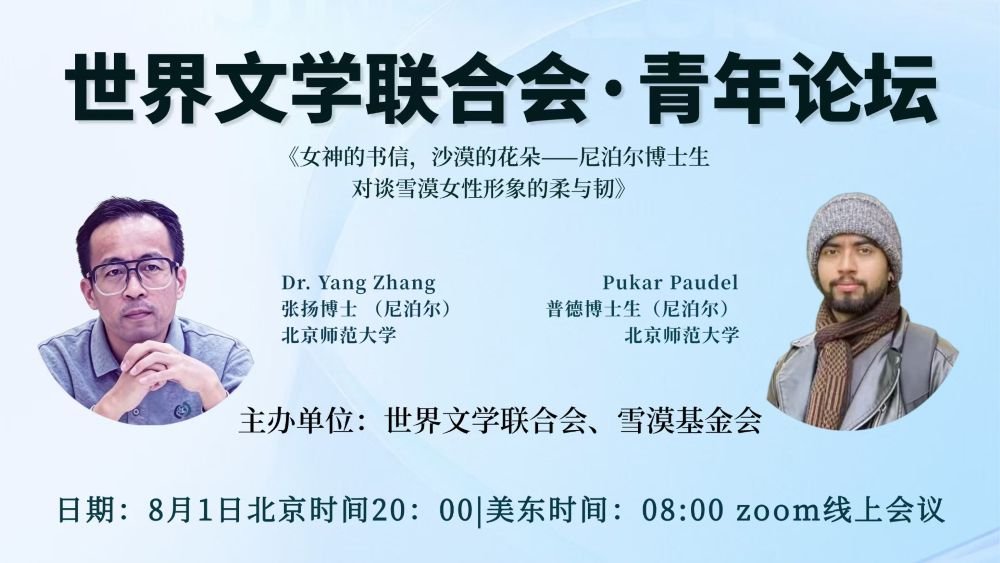
Awakening through Tenderness and
Resilience: Nepali Doctoral Students Discuss Women’s Lives in Xuemo’s Writing |
World Literature Union Youth Forum (Episode 2)
The
second World Literature Union Youth Forum, jointly organized by the World
Literature Union and the Xuemo Foundation, was held online via Zoom at 8 p.m.
Beijing time on August 1, 2026. Under the theme “Letters from a Goddess,
Flowers of the Desert: Nepali Doctoral Students Discuss Tenderness and
Resilience in the Women of Xuemo’s Works,” the forum featured Zhang Yang, a
Nepali scholar and recent doctoral graduate of the Faculty of Education at
Beijing Normal University, and Pude, a Nepali doctoral student in comparative
literature and world literature at the university’s School of Chinese Language
and Literature. More than 200 young scholars, university faculty and students,
and literature enthusiasts from China, Nepal, and other countries participated online
and in person. The forum was coordinated by Xu Yujiao (Joy), secretary of the
World Literature Union and an editor responsible for the international
presentation of Xuemo’s works, and moderated by Lin Mianzhi, who hosts cultural
and tourism events for Lingnan Xuemo Academy and Wuwei Xuemo Academy.
From
Victims to Those Who Choose
Dr.
Zhang Yang delivered a keynote address titled “Becoming Oneself Again in the
Desert: Reading Daughters of the Desert through the Destinies of Lanlan and
Ying’er.” Having grown up in rural Nepal, he was deeply moved by the resilience
displayed by the novel’s two women from western China in desperate
circumstances. He argued that Lanlan and Ying’er are not conventional female
figures “waiting to be rescued.” Rather, under the intersecting pressures of
marital violence, poverty, and traditional constraints, they actively choose to
enter the desert in search of a chance to survive, becoming the novel’s two
central protagonists.
“The desert is not only a geographical space, but also a metaphor for
the conditions of life: poverty is a desert, an abusive marriage is a desert,
losing loved ones is a desert, and prejudice and indifference are deserts as
well.” Zhang argued that Xuemo does not reduce women’s strength to the slogan
of “never breaking down.” Instead, he portrays with sensitivity their genuine
strength in being willing to rise and continue forward even after breaking
down. Lanlan’s rational resilience and Ying’er’s emotional tenacity complement
each other. The “new form of relationship between women” that they build amid
the sound of camel bells, without dependence or self-sacrifice and with mutual
protection, transcends traditional power structures and offers young people
today a spiritual model for “affirming oneself in adversity.”
From
Being Looked At to Writing Oneself
Pude,
in turn, examined the distinctive value of Love Letters from the Goddess from
the perspective of cross-cultural communication. Originally titled Jianxing Ru
Mian: Sha’erwadi de Qingshu, or “Seeing One’s True Nature as If Face to Face:
Saraswati’s Love Letters,” the work grew out of The Undying Diamond Heart. It
tells the story of a Nepali living goddess who is chosen by society and
enshrined for worship, and who, after leaving that role, gradually develops a
sense of herself as a subject through writing love letters.
“Literature has rarely attended to the private lives of Nepal’s
living goddesses after they leave their role. Xuemo has turned his attention to
this seldom-written stage of their lives.” Pude emphasized that the work’s
subtlest achievement lies in its shift of narrative focus, from “how the
outside world defines the goddess” to “how the goddess examines herself.” Here,
letters are not merely a literary form, but a means by which Saraswati reclaims
her voice. Although her awakening remains entangled with waiting for love and
she has not entirely escaped the fate of “being shaped by others,” her
determination to “continue perceiving, judging, and acting amid uncertainty”
embodies the dialectical unity of tenderness and resilience. Tenderness is the
capacity for understanding and empathy; resilience is the courage to take
responsibility for the consequences of one’s choices. Pude also highlighted the
book’s journey from its original Chinese composition into Nepali translation
and then back into a Chinese-language context, describing it as a successful
example of the “reverse circulation” of Chinese literature.
Women’s
Resonance across Borders
In
the discussion that followed, the two scholars exchanged views on the texts.
Asked whether Lanlan and Ying’er could be understood as two sides of the same
female soul, both Zhang and Pude agreed. Pude interpreted the question through
the “Way of the Mean”: “Modern women are often expected to possess both
tenderness and resilience. This is not a division, but the wholeness of life.
Just as Lin Daiyu and Xue Baochai in Dream of the Red Chamber can be seen as
two sides of one whole, Lanlan and Ying’er together form an authentic and
richly realized world of women.”
Qian
Xin, a doctoral student at Fujian Normal University, drew attention to the
scholarly significance of “cultural return.” Pude responded that works of this
kind help fill a gap in Nepali literature’s reflection on its own culture and
promote deeper mutual understanding between China and Nepal at the level of
emotional structures and spiritual foundations. Pude’s younger brother Pujing,
a master’s student at Beijing Language and Culture University, posed a question
grounded in the difficulties facing young people today. Pude responded
pragmatically that “one needs both ideals and love”: “A genuine choice does not
mean sacrificing one for the other in an either-or decision. It means seeking
balance through communication and taking responsibility.”
Possibilities
for Life in Literature
The
conversation lasted more than two hours, moving from the Gobi and yellow sands
of the Hexi Corridor to the light and shadow of Himalayan shrines, and from the
vicissitudes of individual lives to exchange and mutual learning between
civilizations. It brought together textual analysis and personal experience. In
her concluding remarks, moderator Lin Mianzhi observed that although the
transformation of social structures will still take time, individual awakening
is always the starting point of freedom. With their lived quality of
“resilience within tenderness,” the women in Xuemo’s writing not only add a
distinctive radiance to the literature of western China, but also offer an
Eastern literary perspective on women’s issues in a global context.

 |
|
 |
|
 |
|


 Mobile
  雪漠推荐
雪漠推荐
 我心中最精彩的青春——《一个人的西部·致